The Algorithmic Fatigue Index: Why “Dumb” Ads Are Outperforming AI-Optimized Creative in 2026
— New 2026 Data Reveals a Strange Reality: AI Ads Get More Clicks, but Conversion Rates Are Collapsing
By Henry Lawson | Updated on June 2, 2026 | 🕓 14 minutes
Key Highlights
- What is the “Algorithmic Fatigue Index” (AFI), and how can brands measure it?
- How are Meta’s 2026 algorithm updates changing ad performance?
- Why are “imperfect” human-made ads outperforming polished AI campaigns?
- Which industries are most vulnerable to algorithmic fatigue?
- How can marketers combine AI efficiency with authentic human storytelling?
- What warning signs suggest your audience is becoming resistant to AI advertising?
In March 2026, a skincare brand owner in Mumbai posted on Reddit:
“My Meta ad ROAS dropped 23% overnight, and I didn’t change anything.”
It was not an isolated case. That same week, hundreds of posts from Berlin, São Paulo, Jakarta, and other cities flooded into the same discussion thread: AI-optimized ads had suddenly “stopped working.”
But the truth is more complicated than failure. AI did not suddenly become worse. We became smarter. Not advertisers—consumers. People have developed a new reflex: when they see an ad that feels too perfect, they instinctively scroll away.
That brings us to the central concept of this article: the Algorithmic Fatigue Index (AFI).
I. What Is Algorithmic Fatigue? It Is Not “Getting Bored” — It Is “Seeing Through the System”
Traditional ad fatigue is simple: someone sees the same ad too many times and becomes annoyed.
Algorithmic fatigue is different. It happens the very first time you encounter an AI-optimized ad. In about 0.3 seconds, your brain makes several subconscious judgments:
- The color grading feels too “AI”
- I have seen this copy structure before
- That facial expression looks unnatural
- This is an ad — and an AI-made ad
Then you scroll away. Often without realizing you made a decision at all.
In January 2026, Columbia University, Harvard University, Technical University of Munich, and Carnegie Mellon University collaborated with Taboola on a large-scale field study titled AI Ads That Work: How AI Creative Stacks Up Against Humans. The research analyzed more than 5 billion impressions and 3 million clicks. The results showed that AI-generated ads achieved slightly higher click-through rates than human-made ads (0.76% vs. 0.65%). However, once users recognized an ad as AI-generated, engagement dropped significantly.
In other words, the “original sin” of AI advertising is not poor quality. It is that the quality feels too perfect to be believable.
II. What “Dumb” Ads Really Mean: Anti-Algorithmic Creativity
The word “dumb” is intentionally placed in quotation marks. These ads are not actually unintelligent. Instead, they deliberately violate the logic of AI optimization.
Here are several real-world examples.
1. An Australian Artisan Coffee Roaster
At the end of 2025, a small roasting company in Melbourne tested two Facebook ad campaigns:
- Group A: AI-generated product photos with flawless lighting, blurred cinematic backgrounds, and copy optimized by AI
- Group B: A shaky phone-recorded warehouse video filmed by the founder, with loud background noise and the caption:
“We burned three batches before getting this flavor right.”
The result?
Group A achieved a CTR 1.4 times higher than Group B. However, Group B produced a conversion rate 2.1 times higher, with an average order value 34% greater.
The most interesting difference appeared in the comments section:
- Group B received 127 organic user comments
- Group A received only 3
Users wrote things like:
“Finally, an ad that doesn’t look AI-generated.”
2. A U.S. Direct-to-Consumer Fitness Equipment Brand
A brand based in Austin conducted a more rigorous test in Q1 2026.
Together with AI Content Drop, they carried out a 90-day tracking study comparing:
- 30 AI-generated video ads
- 30 human-produced video ads
All campaigns were run on Meta platforms.
The results showed:
- AI ads reached peak CTR between days 3 and 5 (2.3%)
- By day 14, performance had equalized with human-made ads
- By day 30, human-made ads had surpassed AI ads in ROAS (1.7x vs. 1.3x)
AI ad CTR declined roughly 22% per week, while human-made ads declined only 12%.
However, the study included an important limitation.
Researchers admitted they could not fully control the degree of AI assistance inside the “human-produced” ads — for example, editing software with built-in AI tools. In addition, the three test brands (skincare, fitness equipment, and pet supplies) all sold products priced between $30 and $120. Therefore, the findings cannot reliably predict performance in high-ticket categories.
3. A German B2B Industrial Software Company
This may be the most counterintuitive example.
The company sells factory management software priced above €5,000 per contract.
In a private conversation in April 2026 (not public data), the company’s marketing director explained:
“We created 20 LinkedIn ads with AI. CTR looked great, but the lead quality was terrible. Then we replaced everything with a simple photo of an office whiteboard that said: ‘It took us 18 months to finally understand this problem.’ Lead volume dropped 60%, but conversion rates tripled.”
This case has no control group, no statistical significance, and may even involve survivorship bias.
Yet it points toward a direction increasingly supported by broader research.
III. Why Are “Dumb” Ads Winning? Three Core Mechanisms
Mechanism 1: The Trust Gap
In April 2026, YouGov conducted a survey on behalf of Pangram Labs involving 2,557 U.S. adults.
The results showed:
- 69% of online users trust AI-generated content less than human-created content
- 61% said that even suspecting content was AI-generated made them less likely to read or engage with it
This is not a purely rational decision.
It is an emotional defense mechanism.
Human social instincts evolved over millions of years. Deep down, we associate things that look “too perfect” with danger — much like how brightly colored poison frogs instinctively trigger caution.
Mechanism 2: The Attention Paradox
AI-optimized advertising focuses on “winning attention in 3 seconds”:
- brighter colors
- larger text
- stronger contrast
- faster pacing
This strategy works for low-cost impulse purchases under $50.
But expensive purchases require something very different:
three minutes of trust-building instead of three seconds of attention-grabbing.
The January 2026 Taboola study identified a crucial signal:
human faces function as a hidden trust ingredient.
Ads containing clear, large human faces significantly improved credibility and engagement.
Ironically, due to platform policy restrictions, AI-generated ads often included these trust signals more consistently than human-created ads.
This reveals a strange paradox:
AI is being forced to imitate humans, while humans are being forced to compete against AI.
As a result, genuine human traits are becoming increasingly scarce — and therefore increasingly valuable.
Mechanism 3: The Platform Algorithm Backlash
In March 2026, Meta quietly rolled out a major algorithm update with long-term consequences.
The update included three major changes.
1. Attribution Rule Changes
Click-through attribution now counts only actual link clicks.
Likes, comments, saves, and other interactions were moved into a new category called “Engage-through Attribution.”
As a result, many advertisers suddenly saw ROAS figures “collapse” by 15–25%, even though the underlying performance had not changed. The measurement framework itself had changed.
2. Full Rollout of the Andromeda Algorithm
The new system, powered by NVIDIA GH200 chips, processes ad matching 100 times faster than the previous generation and can handle 10,000 times more ad variations simultaneously.
More importantly:
the system automatically determines audience targeting by analyzing creative content itself — including visuals, copy, and format — rather than relying primarily on manually selected audience settings.
3. Accelerated Creative Fatigue
In the Andromeda era, the lifespan of an ad concept has compressed dramatically:
- Previously: around 6 weeks
- Now: roughly 2–3 weeks
Internal Meta data reportedly shows that after users see the same creative four times, average CTR declines by approximately 45%.
What does this mean?
When everyone uses AI to mass-produce “perfect” ads, platform algorithms struggle to distinguish high-quality traffic from low-quality traffic.
The consequence:
- CPMs for AI-optimized ads rose 15–40% after March 2026
- Anti-algorithmic creative concepts often faced less competition and therefore obtained cheaper traffic
IV. The Algorithmic Fatigue Index (AFI): A Simple Diagnostic Framework
Based on the studies above and practical campaign experience, here is a simplified self-assessment framework.
AFI = (AI Creative Ratio × Fatigue Velocity Coefficient) ÷ Creative Diversity Score
Parameter Definitions
- AI Creative Ratio
The percentage of your active ads that are fully AI-generated, from concept to execution. Range: 0–100%. - Fatigue Velocity Coefficient
Platform-specific fatigue multiplier: - TikTok = 1.5 (fastest fatigue)
- Meta Reels = 1.2
- Facebook Feed = 1.0
- YouTube = 0.7
- Creative Diversity Score
A score from 1–10. - If this week’s ads look like slight variations of last week’s templates, score yourself a 2
- If every campaign uses a completely different visual language and narrative structure, score yourself 8–10
How to Interpret AFI
- AFI < 3 → Healthy range, continue monitoring
- AFI 3–6 → Yellow warning zone, increase human creative elements
- AFI > 6 → Red alert, your audience may already be “seeing through” your advertising
Five Warning Signals You Can Detect Without Advanced Tools
1. CTR Is Rising While Conversion Rate Falls
This is the classic signal of deteriorating traffic quality.
AI optimization may be pushing ads toward people who are easy to click but difficult to convert.
2. Comments Like “Another Ad” or “This Looks AI-Generated”
Direct user feedback should never be ignored.
3. Frequency Exceeds 3.0 While CPA Continues Rising
Normally, higher frequency should eventually lower CPA because the algorithm identifies higher-intent users.
If frequency and CPA rise together, the creative itself may already be “poisoning” audience perception.
4. Brand Search Volume Stagnates While Ad Spend Increases
You are paying for traffic, but nobody is actively searching for your brand.
This is often a delayed signal of declining trust.
5. New Customer Ratio Declines While Repeat Purchases Also Fall
This is the most dangerous warning sign.
It means your advertising is not only failing to attract new customers — it may also be damaging existing customers’ perception of your brand.
V. The “Dual-Track” Creative Strategy for 2026
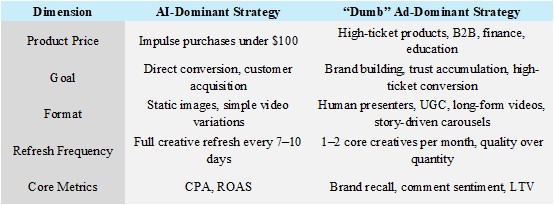
Below is a simplified decision matrix based on product pricing and business type.
Practical Recommendation: Let AI Handle Scale, Let Humans Provide Soul
What AI Should Handle
- Generating A/B testing variations at scale
- Performance analysis
- Bid optimization by region, device, and time slot
- Localization, including multilingual voiceovers
What Humans Should Handle
- Core creative concepts
What is the emotional “soul” of the ad? - Brand voice
If your brand were a person, how would it speak? - Real-world shooting environments
Warehouses, offices, kitchens, streets — messy environments that AI still struggles to simulate authentically - Final quality control
Not merely for error correction, but for injecting genuine human feeling
VI. From “Anti-AI” to “Post-AI”: The Creative Paradigm After 2026
AI is not disappearing.
A 2026 survey by HubSpot and the Content Marketing Association found that 90% of content marketers planned to use AI tools in 2026. AI adoption in marketing reportedly surged from 21% in 2022 to 74%.
But history repeatedly shows a pattern:
When technology allows everyone to achieve an 80/100 level of quality, real competition begins at 80 — not below it.
For individual creators, this means:
your imperfections and your inability to scale perfectly may actually become your moat.
A rough smartphone video from a small Indian business owner may feel more persuasive than a polished AI campaign from a multinational corporation — because audiences know there is a real human being behind it.
For brands, this means building a “human creative seed library.”
Humans create the seed concepts. AI generates variations around those seeds.
The seed must remain human.
AI only waters it.
Conclusion: Returning to the Essence of Marketing
In 2026, we stand at a strange crossroads.
AI has made advertising production cheaper, faster, and more scalable than ever before.
Yet making advertising actually effective has become harder.
The Algorithmic Fatigue Index reminds us of something important:
When technology enables everyone to manufacture perfection, imperfection becomes the new form of authenticity.
AI optimizes for clicks.
Humans optimize for emotion.
Perhaps consumers are simply tired of algorithms constantly telling them what to buy.
They want to hear a real person tell a real story — even if that story includes mistakes, uncertainty, or failure.
That may ultimately define marketing in 2026:
The goal is no longer to defeat the algorithm.
It is to bypass the algorithm and speak directly to human beings.
FAQs
1. Is AI advertising becoming less effective overall?
Not necessarily. AI-generated ads are still highly effective for large-scale testing, personalization, localization, and low-cost direct-response campaigns. However, many advertisers in 2026 are seeing weaker trust signals, lower engagement quality, and declining conversion rates when AI creative becomes too recognizable or repetitive.
2. Which platforms experience creative fatigue the fastest?
Short-form video platforms such as TikTok and Meta Reels generally experience faster creative fatigue due to rapid content consumption cycles and highly aggressive recommendation algorithms.
3. Does this mean brands should stop using AI tools?
No. The article argues for a hybrid approach rather than an anti-AI approach. AI remains extremely useful for scaling production, analyzing performance, localization, and testing creative variations. The key idea is that humans should still control the emotional core and storytelling direction.
4. What kinds of businesses are most affected by algorithmic fatigue?
High-trust industries are often more vulnerable, including:
- B2B software
- Financial services
- Education
- Healthcare
- Consulting
- High-ticket consumer products
In these sectors, consumers typically require deeper emotional trust before making decisions.
5. Can small businesses compete against large brands using authenticity?
Increasingly, yes. One of the article’s core arguments is that authentic, difficult-to-scale human content can outperform expensive AI-optimized campaigns because audiences perceive it as more credible and emotionally real.
References
- Netzer, O., et al. (2026). AI Ads That Work: How AI Creative Stacks Up Against Humans. Field study conducted by Columbia University, Harvard University, Technical University of Munich, and Carnegie Mellon University in collaboration with Taboola. Analyzed hundreds of thousands of live ads, totaling more than 500 million impressions and 3 million clicks. Published January 28, 2026.
- YouGov Plc. (2026). AI Content Trust Survey. Conducted on behalf of Pangram Labs. Sample size: 2,557 U.S. adults. Fieldwork: April 9–13, 2026. Figures weighted and representative of all U.S. adults aged 18+.
- Amra & Elma. (2025). Top 20 AI vs Human Copywriter Performance Statistics 2026. Compilation of studies from Pencil (2026), Zebracat (2026), Boston Consulting (2026), Siege Media (2026), HubSpot (2026), Bynder (2026), and ClickForest (2026). Published September 13, 2025.
- First Page Digital. (2025). Creative Ad Fatigue. Best practices and platform-specific fatigue timelines for Meta, TikTok, YouTube, Google Display, and LinkedIn. Published December 7, 2025.
About the Author
Henry Lawson is an independent analyst and writer focused on artificial intelligence, consumer behavior, and digital commerce. He studies how recommendation algorithms, personalization systems, AI assistants, and online platforms influence the way people discover products, evaluate information, and make purchasing decisions.
Disclaimer
The information in this article is intended for educational and informational purposes only and should not be interpreted as professional financial, legal, advertising, or business advice.