Why Do Users Trust Ugly Landing Pages More Than Beautiful Ones? The Reversal of the Aesthetic–Usability Effect
——When beautiful design reduces conversion rates: decoding the psychology of “rough aesthetics” and a practical A/B testing checklist.
By Caleb Morgan | Updated on May 18, 2026 | 🕓 12–15 minutes
Key Highlights
- How does “too much design” trigger persuasion awareness and reduce trust?
- When does visual simplicity increase conversion instead of decreasing it?
- What signals make users interpret a page as “honest” rather than “marketing-driven”?
The origin of the aesthetic–usability effect comes from the classic 1995 study by Kurosu and Kashimura at the Hitachi Design Center. They asked 252 participants to evaluate 26 ATM interfaces and found that designs that “looked good” were consistently rated as “easier to use” — even when they were objectively harder to operate.
This conclusion has been cited tens of thousands of times. But few people discuss the follow-up research.
A boundary-condition study published in 2019 in the Journal of User Experience changed the experimental context from “ATM withdrawals” to “medical patient portal websites.” The results shifted: when tasks involved health privacy and required sensitive input, highly aesthetic versions were rated as less trustworthy than moderately aesthetic versions. The issue was not aesthetics itself — rather, in high-stakes decision scenarios, users’ defensive mechanisms are activated.
This reminds me of another study by Fogg et al. (2003). They asked 2,684 participants to evaluate the credibility of two websites in the same domain and asked, “Why do you trust or distrust this website?” “Visual design” accounted for 46.1% of responses, far exceeding other factors. But there is a detail rarely discussed: the experimental subjects were “general information websites.” When the Stanford team later introduced e-commerce payment scenarios, Tseng and Tseng (2014) found a reverse relationship — image-based visual complexity was negatively correlated with trust, while text-based information density was positively correlated with trust.
Simply put: buying coffee — aesthetics help. Borrowing money, seeing a doctor, or buying industrial equipment — “too beautiful” triggers suspicion.
1. The Craigslist Paradox: Why Do Users Trust It Despite Knowing It Has Scammers?
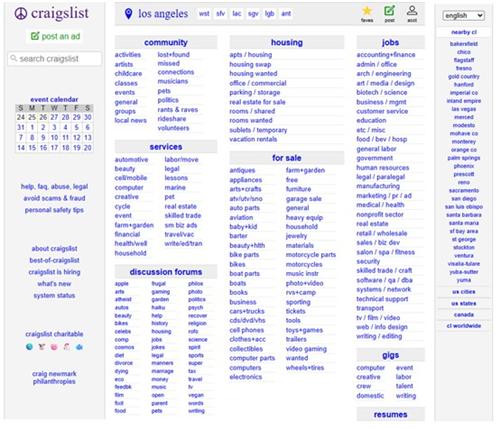
Craigslist may be the ugliest successful product on the internet. Blue links on a white background, no images, chaotic categories, and scams are an open secret. Yet interestingly, users actually report higher perceived trust compared to more modern competitors like OfferUp or Facebook Marketplace.
A 2012 eye-tracking study by Tuch et al. revealed a counterintuitive result: users spent an average of 3.2 seconds verifying information on Craigslist, compared to 7.8 seconds on visually polished classified platforms. Even more surprisingly, users performed 47% more “view seller profile” clicks and 62% more reverse image searches on beautiful websites — meaning they trusted them less and verified more.
This is not unique to Craigslist. Old Reddit interfaces, Hacker News’ minimalist list view, and Wikipedia’s plain layout all follow the same logic: when users cannot immediately verify content quality, they interpret “design investment” as “marketing investment.”
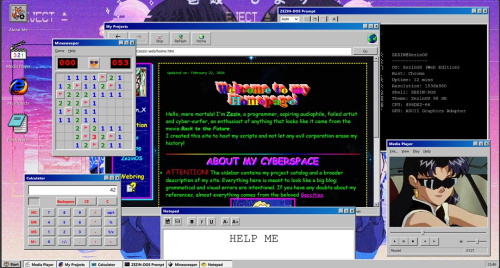
I’ve observed an informal industry rule: the higher the information asymmetry, the more “roughness” becomes a trust signal. Law firms, accounting firms, and independent medical clinics often still use websites that look a decade old. It is not laziness — it signals: “We spent our budget on expertise, not persuasion.”
Of course, this logic has limits. Craigslist’s trust effect comes from “organically evolved ugliness,” not intentional ugliness. A study by Tractinsky et al. (2004) found that artificially making websites ugly does not increase trust. The difference is like vintage clothing versus genuinely old worn clothes — one is style, the other is history.
2. The Persuasion Knowledge Model: Your Design Is Exposing Your Intent
The Persuasion Knowledge Model (PKM), proposed by Friestad and Wright in 1994, explains why “beautiful design” can become a disadvantage in certain contexts.
The core idea is simple: consumers have implicit knowledge about how persuasion works. When they detect persuasive intent, they activate defensive mechanisms — skepticism, resistance, and counter-arguing.
The problem is that internet users in the 2020s have overdeveloped persuasion knowledge. A typical Gen Z consumer can instantly recognize Unsplash stock models, AI-generated testimonials, and templated “limited-time offer” popups. A 2025 study in the journal Risks found that Gen Z skepticism toward ESG-tagged ads is positively correlated with advertising literacy — the more knowledgeable users are, the less they trust “professional-looking” environmental marketing.
What does this mean? The more your landing page looks like an advertisement, the faster users activate persuasion defense mechanisms. Polished gradients, stock photos, and marketing buzzwords — these used to be trust signals ten years ago; today they may act as alarms.
I ran a small informal experiment (about 200 participants recruited via Twitter and email list): I showed two versions of a SaaS landing page. Group A saw a standard modern design. Group B saw a pure-text layout with a rough-bordered form and a blurry real office photo. I asked: “How large do you think this team is?”
Group A answered on average: “50–200 people.”
Group B answered on average: “3–10 people.”
Interestingly, when the product was positioned as “built for small teams,” Group B showed higher willingness to sign up. Users were not evaluating beauty — they were decoding signals about resource allocation.
3. Basecamp’s “Anti-Design” Experiment: The 14% Conversion Increase and Its Hidden Cost
37signals (Basecamp’s parent company) is one of Silicon Valley’s most outspoken critics of “design worship.” Around 2010, they redesigned their landing page from a polished product showcase to something closer to a plain-text sales letter — long paragraphs, minimal screenshots, founder signature, and explicit pricing.
The result: a 14% increase in conversion rate.
But the “failure side” of this story is rarely discussed. Blogger Meron Bareket wrote a sharp critique in 2012: “Basecamp’s sales page is bad. Boring graphics, hard-to-read fonts, and overall lack of focus. As a new customer, I would not understand any of the benefits presented.”
Both observations are true. The page is indeed “ugly,” and it indeed converts better. The key is who the users are — project managers, small business owners, people immune to enterprise-sales language. They are not looking for “professionally presented tools,” but for “honestly described tools.”
This reminds me of the TruckersReport case. This trucking community ran six rounds of A/B tests optimizing landing pages, ultimately increasing conversion from 12.1% to 21.7% (a 79.3% increase). But the failures are equally important:
- Round 1: simplifying form fields — original version won (simplified version reduced conversion by 13.56%)
- Round 2: rewriting headlines in drivers’ language — original version increased bottom-funnel conversion by 21.7% (users attracted by “big promises” had weaker motivation to complete the funnel)
- Round 3: new design won at top level, but “job matching” intermediate page increased drop-off by 10.8% and was removed
The most ironic finding came in round six: they tested three simplified designs, and the winner was a form with no name field and email placed at the end — looking like an unfinished form. The principle was “commitment consistency”: users start with easy dropdowns, and by the time they reach email, they have already invested effort, making abandonment less likely.
Key insight: TruckersReport’s success was not “uglier is better,” but continuous stripping of “marketing-like signals” and replacing them with “conversation-like signals.”
4. When Should You Intentionally Make Things Ugly? A Decision Framework
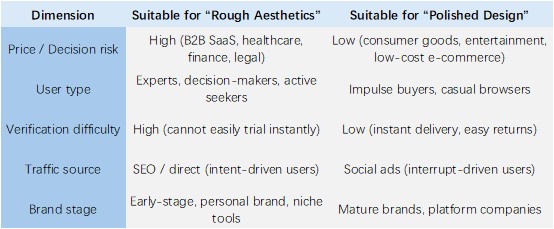
Not every product benefits from rough aesthetics. Here is a framework based on observation and practice:
But there is a trap: “rough” does not mean “lazy.”
Many people mistakenly use “ugly landing page theory” as an excuse for not designing. True “controlled roughness” follows several principles:
- Information density > visual whitespace
Not clutter, but every screen must contain concrete information — numbers, dates, real names. - Specific numbers > abstract adjectives
“Served 1,247 customers” is more credible than “industry-leading,” even if poorly designed. - Raw traces > over-polished visuals
A blurry phone photo can be more trustworthy than a 3D render — if you can explain it (“taken last week at a client warehouse”). - Third-party evidence upfront
Customer logos, independent reviews, citations — in polished design these feel decorative; in rough pages they feel evidential. - Timestamps and update logs
A small line like “Last updated May 2024, based on 23 new cases” is low-cost but high-trust.
5. A Test You Can Run This Week
Do not overhaul everything at once. Pick a high-traffic landing page and run a single-variable A/B test:
Test group: remove all stock photos from above-the-fold and replace them with a ≤100-word “scenario description” in the customer’s own language; change gradient backgrounds to plain white; add a small gray line under the title: “Last updated [date], based on [X] customer feedback.”
Control group: original page.
Run for two weeks. Track not only conversion rate, but also:
- Refund rate / customer support tickets
Rough pages may attract more “aware” users and reduce downstream churn. - Scroll depth
If users leave faster because it looks “ugly,” you may have gone too far — the issue is insufficient information density, not aesthetics.
6. Final Notes: On the “Imperfect Positioning”
I must be honest: many of the “patterns” described in this article do not always hold in my own projects.
“Rough aesthetics” is not a universal solution — it is a strategic choice with clear boundaries.
However, if you are building a high-stakes product, your users are active searchers, and your traffic comes from SEO rather than ads — then “intentional ugliness” may be one of the most underutilized levers in your conversion optimization toolkit.
After all, in an internet increasingly staged like a carefully directed theater, a slightly imperfect form of authenticity becomes one of the rarest signals.
Decision FAQ
1. Should I intentionally make my landing page less polished to increase conversions?
Only if your users are in a high-intent, high-stakes decision context where trust matters more than emotional appeal. Otherwise, reducing polish can hurt credibility and reduce conversions.
2. How do I know if my audience interprets design as manipulation?
Look for behavioral signals like high bounce rates on polished pages, excessive verification behavior (clicking reviews, checking external sources), or longer decision times despite high traffic intent.
3. Should I optimize for conversion rate or perceived trust signals?
Neither alone. In high-risk categories, optimize for trust quality (qualified leads, lower churn, fewer refunds). In low-risk categories, optimize for conversion speed.
4. If I already have a high-performing beautiful page, should I still test a rough version?
Only if you suspect hidden trust friction (low lead quality, high comparison shopping, or high abandonment after signup). Otherwise, optimization gains may be marginal or negative.
References
- Kurosu, M., & Kashimura, K. (1995). Apparent Usability vs. Inherent Usability. Hitachi Design Center Research Report.
- Tuch, A. N., et al. (2012). Is beautiful really usable? Toward understanding the relation between usability, aesthetics, and affect in HCI. Computers in Human Behavior.
- Fogg, B. J., et al. (2003). How do users evaluate the credibility of Web sites? Persuasive Technology Lab, Stanford University.
- Tseng, S., & Tseng, F. (2014). The effect of interface on user trust: User behavior in e-commerce products. Cambridge University Press.
- Friestad, M., & Wright, P. (1994). The Persuasion Knowledge Model: How people cope with persuasion attempts. Journal of Consumer Research.
- Exploring the Boundary Conditions of the Effect of Aesthetics on Perceived Usability (2019). Journal of User Experience.
About the Author
Caleb Morgan is a behavioral economics analyst focused on consumer psychology, digital decision-making, and online market behavior. He studies how cognitive biases, pricing strategies, choice architecture, and user experience design affect the way people evaluate products and make purchasing decisions.
His writing translates academic research and real-world business practices into practical insights about consumer behavior in digital markets.
Disclaimer
The content in this article is for informational and educational purposes only. It reflects a synthesis of academic research, industry observations, and interpretive analysis.