Is Slow Fashion Actually More Expensive? A Lifecycle Cost Analysis of Sustainable Wardrobes
Most people calculate the real cost of clothing completely wrong.
By Victoria Lane | Updated on May 10, 2026 | 🕓 14 minutes
Key Highlights
- Is “cost per wear” actually hiding the real cost of clothing?
- Why can a cheap fast-fashion item end up costing more over time?
- How do maintenance and time costs change the economics of slow fashion?
- Why do many sustainable fashion pieces have surprisingly poor resale value?
- Which clothing items are worth investing in — and which are not?
- Can buying fewer clothes matter more than buying “ethical” clothes?
Why “Cost Per Wear” Is an Oversimplified Lie
The term “slow fashion” was borrowed from the Slow Food movement. It is not a strict industry standard so much as a loosely connected set of ideas: making clothes with more durable fabrics, more timeless silhouettes, and more transparent supply chains so they can be worn longer. Its opposite is “fast fashion” — the Zara, H&M, and SHEIN model of releasing new products weekly and making them obsolete seasonally.
If you have ever searched “Is slow fashion more economical?”, almost every article gives you the same formula:
Cost Per Wear = Price ÷ Number of Times Worn
It sounds rational, but in real life, the formula ignores at least four different costs.
The first is maintenance cost: dry cleaning, specialty detergents, repairs, waterproofing treatments.
The second is time cost: hand-washing a shirt can take 45 minutes. If you convert that time into even minimum hourly wages, the price of many “sustainable” garments effectively doubles.
The third is storage and depreciation: closet space is not free. Fabric oxidation, moth damage, and shape distortion caused by long-term storage are all silent expenses.
The fourth is residual value and liquidity: a $400 niche designer coat may sit on a resale platform for three months before finally selling for $80, while an $80 Uniqlo jacket may only resell for $15 but move five times faster. Your “return” is not just about the amount recovered — it is also about how long you wait to recover it.
The more honest framework is Lifecycle Cost Analysis (LCCA). Originally used in engineering and manufacturing, it turns out to be surprisingly effective for wardrobe management:
Total Lifecycle Cost = Purchase Cost + Maintenance Cost + Time Cost + Disposal Cost − Residual Value
Using this framework, I am going to criticize both fast fashion and slow fashion equally.
Fast Fashion’s Cheapness Is a Cognitive Illusion
The Ellen MacArthur Foundation noted in A New Textiles Economy (2017) that the world produces more than 100 billion garments every year, while the average number of times clothing is worn has fallen by 36% over the past fifteen years.
Another dataset from WRAP’s Valuing Our Clothes (2017) found that roughly 30% of clothing in British consumers’ wardrobes had not been worn once in the previous year.
Behind these numbers is an overlooked behavioral phenomenon:
Fast fashion exploits flaws in human mental accounting.
Most people struggle to mentally equate five separate $30 purchases with one $150 purchase. Those five $30 purchases are spread across different months and different stores, so the brain never adds them together into $150. But paying $150 all at once for a slow fashion item creates an immediate and painful sense of spending.
In the fall of 2023, I conducted an informal tracking experiment.
I bought five fast-fashion basics: two T-shirts, one pair of jeans, one knitted cardigan, and one shirt, for a total of around $180. I tracked their actual wear frequency for an entire year.
The result was disappointing.
One T-shirt turned into sleepwear after only three washes because the collar lost its shape. The jeans became uncomfortable around the crotch whenever I sat down and were abandoned after four wears. The shirt’s button stitching loosened, and by the sixth wear a button fell off. I still have not sewn it back on.
Out of the five pieces, only two ever reached what I would call “normal wear” status.
The total real wear count was around 35.
So the real CPW was not:
$180 ÷ an imagined 100 wears
It was:
$180 ÷ 35 = $5.14 per wear
For comparison, I own a $220 merino wool sweater that I have worn around 80 times. Its surface-level CPW is $2.75 per wear.
But even that figure excludes dry-cleaning costs and the time cost of hand-washing it in cold water because I was afraid of shrinkage.
That is the real issue: fast fashion is not genuinely cheap. It simply hides and fragments its costs.
The costs are shifted into constant replacement, psychological abandonment, and invisible waste.
The Hidden Costs of Slow Fashion: The Part Nobody Likes to Discuss
This is the least discussed part of the conversation — and the part brands most hope you never calculate honestly.
The Maintenance Cost Trap
I once interviewed a reader living in Berlin who bought a €450 sustainable cashmere coat in 2022. The brand marketed it as a “lifetime garment.”
In the first year, she spent €160 on professional dry cleaning because the label said “dry clean only.”
In the second year, wear appeared on the shoulders, and repairs cost another €90.
In the third year, she moved to southern Spain and realized winters there were far too warm for such a heavy coat.
In total, she wore it around 50 times while spending approximately €700 overall.
She later emailed me and said:
“I thought I was making an investment. Instead, I was maintaining a pet.”
The Violence of Time Costs
Another friend living in Tokyo bought natural linen shirts that required hand washing.
Every washing cycle — cleaning, reshaping, and laying flat to dry — took roughly 40 minutes.
Using the local minimum part-time wage of ¥1,000 per hour, the “time tax” per wear was around ¥667.
The shirt itself cost ¥12,000, and she estimated she would wear it 40 times. The surface-level CPW looked like ¥300 per wear.
But once time cost was included, the real CPW jumped to ¥967 per wear.
She laughed bitterly and told me:
“I’m not wearing a shirt. I’m wearing housework.”
The Cruel Reality of Residual Value
According to ThredUp’s Resale Report (2024), the secondhand market is growing overall, but “sustainable niche brands” have significantly lower resale velocity than mass-market brands.
The reason is simple:
Mainstream brands have standardized sizing and broad recognition, so buyers feel safer purchasing them. Niche brands have tiny buyer pools and inconsistent sizing systems.
I once tried selling a $350 independent designer blazer on a resale platform. It sat unsold for four months before finally selling for $70 — after two separate buyer returns.
Meanwhile, a $90 Massimo Dutti blazer sold within a week for $20.
Residual value is not just about price.
It is also about liquidity.
The Green Premium Nobody Talks About
There is also an unspoken industry rule inside sustainable fashion pricing:
If the price is not three to five times higher than fast fashion, consumers will not perceive it as “ethical.”
In The State of Fashion (2024), McKinsey & Company observed that the “green premium” in some categories reaches as high as 60%, yet not all of that markup comes from better materials or craftsmanship.
Part of what consumers are paying for is moral signaling and brand storytelling.
And that premium is something you will never recover simply by “wearing it more.”
I am not saying slow fashion is a scam.
I am saying this:
The cost structure of slow fashion is far more complicated than brands want consumers to believe.
Success Stories, Failures, and the Gray Areas in Between
Success Case: The 10-Year Boot
A reader living in the Scottish Highlands bought a pair of Goodyear-welted work boots in 2014 for $420.
Over ten years, he replaced the soles three times ($75 each) and the heels twice ($40 each).
Total cost: $765.
He wore the boots across farms, cities, and mountain terrain for more than 900 wears.
His CPW came out to around $0.85 per wear.
More importantly, the expense smoothed his cash flow. He never faced a sudden month where his boots unexpectedly failed and forced an emergency replacement purchase.
That predictability has economic value in itself.
Failure Case: The Sustainable Wedding Dress
A bride in California bought a $1,200 organic silk wedding dress marketed as “heirloom quality.”
She wore it for six hours.
When she tried reselling it, she discovered that secondhand wedding dresses have an extremely narrow market. Who wants to buy a wedding dress somebody else already wore?
On top of that, organic silk stains more easily from sweat and makeup than standard silk, reducing resale potential even further.
Eventually, she donated the dress to a theater group and received a $50 tax deduction receipt.
She later admitted:
“Renting a $400 dress — or buying a $200 dress and altering it — probably would have created a smaller environmental footprint and definitely made more financial sense.”
Situations Where Fast Fashion Is Actually Rational
Fast fashion should not be rejected entirely.
There are at least three situations where it is the logical choice:
- Style experimentation
If you are unsure whether a color or silhouette suits you, spending $25 to experiment is smarter than spending $250 only to discover it does not work. - Children’s clothing
Children outgrow sizes every six months. The durability advantage of slow fashion is directly canceled out by biological growth. - Extremely low-frequency items
If you live in a tropical climate and only need a down jacket for a five-day trip to Northern Europe, renting one or buying a $60 fast-fashion jacket makes far more sense than investing in a $600 “lifetime” version.
The real distinction is not “slow fashion vs fast fashion.”
It is:
“High-frequency core items” vs “low-frequency peripheral items.”
The former deserves serious LCCA analysis.
The latter often does not deserve that much thought at all.
A Practical Decision Framework for Ordinary People
Do not try to rebuild your entire wardrobe at once.
That usually leads to decision fatigue and ultimately changes nothing.
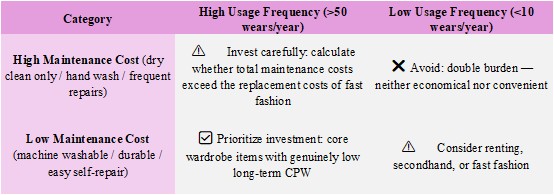
Instead, pick the item you currently wear most often and evaluate it using the following framework.
The LCCA Wardrobe Matrix
The 30-Second LCCA Checklist
- How many times will I realistically wear this?
Be honest. Do not rely on optimistic fantasy. Look at your actual wear history for similar items. - What are the maintenance costs?
Check the care label. Check dry-cleaning prices in your city. If the label says “dry clean only,” add the cleaning cost into the total purchase price before dividing by expected wears. - If I stop liking it, how quickly and for how much can I resell it?
Search resale platforms for historical selling prices of similar items from the same brand. - Is this a core item or a peripheral item?
Core items — daily commuter coats, frequently worn jeans — justify higher budgets. Peripheral items — formal dresses, ski wear — usually do not.
A Gradual Way to Apply This in Real Life
Do not start by asking, “What should I buy?”
Start by observing what you are already buying.
Open your online shopping history or credit card statements from the past twelve months and total your clothing expenses.
Then open your wardrobe and count how many items you actually wore more than ten times in the past year.
Divide total clothing spending by actual wears.
The number you get is your personal baseline CPW.
For most people, it is a sobering experience.
Then make just one change:
Find the item you wear most often that also has the highest maintenance cost, and replace it with a lower-maintenance alternative.
For example, replace dry-clean-only shirts with machine-washable versions.
That single adjustment alone can meaningfully lower your real clothing costs.
Conclusion: Honesty Matters More Than Morality
In Sustainability and Circularity in the Textile Value Chain (2020), UNEP noted that a substantial share of fashion’s environmental damage comes from overconsumption — regardless of whether the purchases are fast fashion or slow fashion.
Buying one “sustainable” garment you do not need may be just as environmentally wasteful as buying three unnecessary fast-fashion items.
Fashion Revolution’s Consumer Survey (2023) also found a significant gap between consumers who claim to care about sustainable fashion and their actual purchasing behavior.
Part of that gap exists because people are pushed by moral narratives into making financially irrational decisions. When those purchases become too expensive or too burdensome to maintain, they are abandoned anyway, creating waste all over again.
Slow fashion is not automatically more expensive.
Fast fashion is not automatically cheaper.
The answer depends on three variables:
Actual wear frequency, real maintenance costs, and the value of your time.
The greatest enemy of sustainable consumption is not fast fashion.
It is self-deception.
Deceiving yourself into believing you will wear something often.
Deceiving yourself into believing maintenance inconvenience does not matter.
Deceiving yourself into believing “expensive equals responsible.”
Calculating an honest cost is more valuable than buying any label.
Frequently Asked Questions
1. Which clothing categories benefit most from lifecycle cost analysis?
Lifecycle Cost Analysis (LCCA) works best for high-frequency wardrobe items that are worn repeatedly over multiple years. Categories such as winter coats, work shoes, denim, everyday bags, commuter jackets, and knitwear usually justify deeper cost analysis because maintenance, durability, and replacement cycles materially affect their long-term value.
By contrast, low-frequency items — wedding attire, trend-driven statement pieces, vacation clothing, or occasion wear — often do not benefit as much from detailed LCCA calculations because they are used too infrequently for durability advantages to offset higher upfront costs.
In simple terms: the more often you wear something, the more important lifecycle economics become.
2. Why do some expensive sustainable brands perform poorly in resale markets?
High price does not automatically create strong resale demand.
Many sustainable or independent fashion labels operate in niche markets with limited brand recognition, inconsistent sizing systems, and smaller buyer pools. While consumers may appreciate the ethics or craftsmanship when purchasing new, secondhand buyers tend to prioritize familiarity, fit predictability, and price confidence.
As a result, some mainstream brands with broader recognition can resell faster — even if their original quality is lower.
Liquidity also matters. A garment that theoretically retains 40% of its value but takes six months to sell may be economically less useful than a cheaper item that sells within days.
3. How much should time cost matter when evaluating clothing?
For many consumers, time cost is one of the most underestimated parts of wardrobe economics.
Garments that require hand washing, steaming, ironing, reshaping, air drying, waterproof treatments, or frequent repairs create ongoing labor obligations. Over time, those invisible tasks accumulate into meaningful economic costs.
This matters especially for people with demanding schedules, long commutes, caregiving responsibilities, or high hourly earnings. A shirt that requires 40 minutes of maintenance after every wear may become dramatically more expensive than its retail price suggests.
References
1. Ellen MacArthur Foundation. (2017). A new textiles economy: Redesigning fashion’s future. Ellen MacArthur Foundation. https://ellenmacarthurfoundation.org/
2. Fashion Revolution. (2023). Fashion Revolution consumer survey 2023. Fashion Revolution. https://www.fashionrevolution.org/
3. McKinsey & Company. (2024). The state of fashion 2024. McKinsey & Company & The Business of Fashion. https://www.mckinsey.com/
4. ThredUp. (2024). 2024 resale report. ThredUp. https://www.thredup.com/resale/
5. United Nations Environment Programme (UNEP). (2020). Sustainability and circularity in the textile value chain. UNEP. https://www.unep.org/
6. WRAP. (2017). Valuing our clothes: The cost of UK fashion. WRAP. https://wrap.org.uk/
About the Author
Victoria Lane is a consumer economy analyst and writer covering changing patterns of work, spending, and everyday life. She focuses on how demographic shifts, sustainability trends, technological innovation, and evolving consumer values are reshaping markets around the world.
Her work combines economic research, market analysis, and real-world case studies to explain the forces driving long-term changes in consumer behavior.
Disclaimer
This article is intended for informational and educational purposes only. The views expressed are based on publicly available research, industry reports, personal observations, and anecdotal examples. References to brands or products are for illustrative purposes only and do not constitute endorsements or criticisms of any company.