Anchoring 2.0: How the First Price a User Sees on Google Determines Their Willingness to Pay for 6 Months
— Traditional anchoring-effect research focused on deliberate number games at the negotiation table. But in the Google era, the real psychological battle no longer happens in negotiations. It happens the moment you casually search something and see a number. Six months later, that number may still be shaping what you are willing to pay.
By Caleb Morgan | Updated on April 22, 2026 | 🕓 12 minutes
Key Highlights
- Why do people still “feel” a price is reasonable months after forgetting the exact number?
- How does Google Search create stronger long-term price anchors than traditional advertising?
- Why do Featured Snippets and AI Overviews influence willingness to pay more subtly than ads?
- How can consumers intentionally “re-anchor” themselves before major purchases?
In 2018, the Journal of Travel Research published a hotel-booking experiment. Researchers showed one group of consumers a high price first and another group a low price first, then asked how much they would be willing to pay for a room.
The results were strange. A high-price anchor did increase willingness to pay, but a low-price anchor did not lower it. Instead, it made participants feel that “maybe this product is not worth much.” Even more interestingly, when the high anchor was too far from the participant’s own budget, its psychological power disappeared entirely.
The experiment exposed an overlooked issue: the strength of anchoring depends on the consumer’s psychological state at the moment they encounter the price.
In laboratory settings, participants know they are “evaluating prices.” But on a Google search results page, you may simply be looking up information, replying to emails, or helping your boss find data. You are not trying to buy anything, yet you passively encounter “$29/month.” Six months later, you may have forgotten the exact number, but the “feeling” it created remains.
This is Anchoring Effect 2.0: not an intentional negotiation tactic, but the long-term seepage of fragmented numbers encountered unintentionally.
I. Why the Google Search Results Page Is the “Perfect Anchoring Environment”
Traditional anchoring theory (Tversky & Kahneman, 1974) argues that people rely too heavily on the first number they see and then make insufficient adjustments. But most research over the last fifty years was conducted either in laboratories or at negotiation tables.
Google’s SERP breaks three key assumptions behind classic anchoring research.
Passive Exposure
You are not comparing prices. You are searching for answers. A Featured Snippet or AI Overview suddenly throws “$99/month” at you, and your brain never activates a “price defense mechanism.” The number gets recorded like background music in memory, but later becomes the baseline for comparison.
Fragmentation
Prices on SERPs usually appear as isolated numbers without context. A 2025 online-shopping study using structured questionnaires and non-probability convenience sampling found that more than half of respondents were influenced by crossed-out prices, while another group explicitly claimed they were unaffected and even became suspicious of deep discounts.
Anchoring is not universal, but in digital environments it becomes more invisible. Often, you do not realize you have been anchored at all.
Authority Signaling
Ads and snippets ranked in the top three positions are subconsciously encoded as the “market standard price.” This is not rational judgment. It is cognitive laziness.
More importantly, there is the issue of time. Traditional studies focused on immediate decisions, but how long do digital traces remain psychologically active?
In 2017, Lempert et al. (Cognition, Cohen’s d = 0.4) found that recalling positive memories after three days could reduce delay discounting, though the effect was “fragile and context-dependent.” Explicit memory may fade after several weeks, but implicit memory leaves behind a “gut feeling” that may persist for months.
II. Three Types of Google First-Price Anchoring Paths
Based on how pricing information appears in the SERP, anchoring follows at least three different pathways, each with a different decay cycle.
Path A: Ad Anchors (Decay in 3–4 Months)
Promotional prices at the top of Google Ads are the most visually prominent.
A Stanford working paper found that purchase prices can be influenced by arbitrary anchors, such as the last two digits of a Social Security number, while selling prices are influenced only by perceived market value anchors.
This suggests that ad anchors carry an implicit “promotional discount” label. Users subconsciously recognize them as temporary deals and mentally discount them slightly. As a result, their influence fades relatively quickly.
Path B: Snippet Anchors (5–6 Months, the Most Invisible)
Prices extracted into Featured Snippets or AI Overviews are more likely to be interpreted as “objective answers.”
Ahrefs research in 2025 found that many users remain skeptical of snippets, with some even suspecting they are paid placements. Yet paradoxically, even users who distrust them still unconsciously use those prices as comparison benchmarks later.
Because these numbers are encoded as “knowledge” rather than “advertising,” they decay more slowly.
Path C: Comparison Anchors (Range Anchoring Across Entire Industries)
Price ranges shown in “People Also Ask” sections or comparison tables, such as “$50–$200,” do not anchor users to one exact number. Instead, they establish a “reasonable range.”
Six months later, prices outside that range trigger instinctive resistance.
A 2024 B2B sales experiment by Bergers et al. involving 86 full-time salespeople earning approximately $70,000 annually showed that salespeople given a reference discount of 26% offered customers an average discount of 25.55%, while those given an 8% reference offered only 7.93%.
The upper boundary of the range anchored the perceived acceptable concession space.
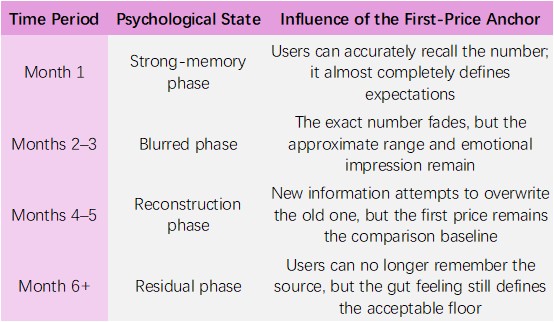
III. The 6-Month Influence Curve
I attempted to sketch an influence-decay curve. This is not a strict experimental conclusion, but an inference based on psychological principles and commercial observation.
The core insight is this: six months later, you may not remember the exact price you first saw, but you can still feel what seems reasonable.
IV. Real-World Cases: None of the Outcomes Were Perfect
1. QuickBooks Price Increases — Anchoring Backlash and User Segmentation
In the United States, QuickBooks users entered at around $60 per month in 2023. By 2025, the price had increased to $75.
The original anchor remained psychologically fresh enough that users perceived the increase as “unfair.”
But then segmentation appeared. Heavy users silently accepted the increase because switching costs were too high, while low-frequency users churned in large numbers.
The strength of anchoring appears inversely related to how deeply embedded the product is in the user’s workflow — a boundary condition rarely discussed in textbooks.
2. SearchPilot’s SEO Title Price Experiment — When Anchoring Backfires
SearchPilot ran an SEO experiment that added static prices to ecommerce title tags under the assumption that click-through rates would improve.
The results were negative.
Differences between the static price displayed in search results and the actual landing-page price increased bounce rates and reduced brand trust. Later experiments with dynamic pricing performed somewhat better, but search-engine crawling frequency could not keep up with real-time pricing updates.
Anchoring is not a one-way weapon. A low-price anchor paired with a high-price landing page creates a feeling of deception.
3. Ethiopian Farmers — Learning Effects Overpower Anchoring
A 2024 World Bank field experiment provided small farmers in Ethiopia with temporary free subsidies for integrated pest management packages.
The subsidy initially anchored expectations around what constituted a “reasonable price.” However, once farmers learned the actual value of the product through experience, the learning effect eventually overpowered the anchor, and long-term technology adoption was promoted rather than suppressed.
The implication is important:
When product value can be verified through direct experience, first-price anchoring can be corrected by learning.
For SaaS companies, this means free trials do not automatically neutralize anchoring. If users fail to perceive value during the trial, the trial may instead reinforce the anchor that “this product should be cheap.”
4. “Rational Resisters” in Online Shopping
A 2025 online-shopping anchoring study using structured questionnaires and convenience sampling confirmed that although most people were affected, a meaningful subgroup explicitly reported being unaffected by reference prices.
In ecommerce digital-priming experiments, high-anchor effects on willingness to pay produced an effect size of only d = 0.12, considered a small effect.
When a more relevant anchor such as MSRP was present, unrelated numerical priming effects disappeared entirely.
In real markets, anchoring effects are often much smaller than laboratory findings suggest.
V. What You Can Do
If You Build Products (High-Priced or Mature Products)
- Own the snippet anchor. Optimize content to win Featured Snippets, and ensure AI Overviews extract prices with context, such as “$99/month including automated reporting,” rather than displaying an isolated number.
- Maintain a safe distance between promo and full prices. Promotional prices should not be dramatically lower than regular prices. Stanford research suggests that when uncertainty becomes salient, selling prices become sensitive to arbitrary anchors. Consumers confronted with extreme discounts may encode the lower number as the “real value,” making the full price appear deceptive.
- Use contextual pricing SEO. Naturally explain why the product costs what it does. Google snippets may extract supporting value statements alongside the number, reducing the strength of isolated anchoring.
If You Build Products (Low-Cost, New, or Disruptive Products)
- Do not compare prices directly. In SEO content, avoid opening with “We only cost $X.” Start by discussing the cost-structure problems of traditional solutions. Redefine the anchor instead of fighting within it.
A 2024 multiple-anchoring study found that when the gap between external reference prices and consumers’ internal reference prices becomes too large, a contrast effect emerges. Consumers judge the external anchor as unbelievable, causing it to fail entirely.
If you directly use a low price to fight against a high anchor, the brain may automatically reject it.
- Redefine the category. If the market range is $50–$200, do not force yourself into the market by saying “We cost only $10.” Instead, explain that “this is not the same category of product.”
- Match a six-month nurturing cycle. A user may see your price today but convert six months later. Your email and retargeting cadence should evolve accordingly: reinforce value in month one, introduce social proof in month three, and create urgency in month six.
If You Are a Consumer
- Re-anchor yourself intentionally. Before making a major purchase, search again in incognito mode and compare the current SERP price distribution with the “reasonable price” stored in your memory.
- Start with value, not price. Define your needs first, then match products to prices. Sequence matters. Seeing prices before defining needs creates the ideal environment for anchoring.
- Use the six-month rule. If you searched for a product six months ago and are making a decision today, remind yourself: “That number has expired. I need a new benchmark.”
VI. An Honest Note
The “six-month curve” currently lacks direct longitudinal experimental evidence.
Most anchoring studies are cross-sectional and completed in a single session. My inference comes from cross-domain mapping between episodic-memory research and delay-discounting literature. It is a theoretical extrapolation, not a proven empirical conclusion.
Cultural differences may also moderate anchoring strength.
Consumers in high-context cultures, such as Japan or many Arab societies, may rely more heavily on relationships and brand trust, making them less sensitive to isolated numerical anchors.
The 2025 online-shopping study also acknowledged that its non-probability convenience sample limited generalizability.
High-involvement decisions, such as buying a house or purchasing enterprise software, activate more deliberate thinking and partially offset anchoring effects.
Low-involvement decisions, such as subscription boxes or food-delivery apps, rely heavily on intuition, making anchoring effects much stronger.
The phenomenon cannot be generalized universally.
Conclusion
The real battlefield of pricing strategy is not the checkout page. It is the moment a user performs their first Google search — and the influence may last for six months.
Understanding this is not about manipulating consumers more effectively. It is about recognizing a cognitive reality of the digital age:
we believe ourselves to be rational comparers, but most of us are actually prisoners of memory.
As AI Overviews increasingly answer the question, “How much should this cost?” directly, will first-price anchoring become stronger or weaker?
There is still no definitive answer.
But one thing is already clear:
Whoever controls the narrative around the first price gains an asymmetric advantage in the battle for consumer willingness to pay over the following six months.
Frequently Asked Questions
1. Do users remember the exact price they first saw?
Often, no. Research suggests that explicit memory for the exact number may fade relatively quickly, while emotional impressions and “reasonable price ranges” can remain active for months.
2. Why do static prices in SEO titles sometimes fail?
If the price shown in search results differs from the landing-page price, users may feel manipulated. This can increase bounce rates and damage brand trust.
3. Is there direct evidence that anchoring lasts six months?
Not yet. Most anchoring studies examine short-term decisions. The six-month framework in this article is a theoretical interpretation based on memory research, delay discounting literature, and observed digital consumer behavior patterns.
References
- Tanford, S., Choi, C., & Joe, S. J. (2018). How Pricing Strategies Influence Willingness-to-pay. Journal of Travel Research.
- Palmeira, M., & Srivastava, J. (2013). How Is Willingness to Pay Formed under Multiple Anchors? Frontiers in Psychology, 4, 393 (n=118, n=115).
- Short-run Subsidies and Long-run WTP: Ethiopia Agricultural Experiment. (2024). World Bank Research.
- Lempert, K. M., et al. (2017). Episodic Memory on Delay Discounting. Cognition, 166 (Cohen’s d = 0.4, replicated d = 0.29).
- Online Shopping and Anchoring Effect Study. (2025). Annals of Ovidius University, Vol. XXV, Issue 1 (Non-probabilistic convenience sample).
About the Author
Caleb Morgan is a behavioral economics analyst focused on consumer psychology, digital decision-making, and online market behavior. He studies how cognitive biases, pricing strategies, choice architecture, and user experience design affect the way people evaluate products and make purchasing decisions.
His writing translates academic research and real-world business practices into practical insights about consumer behavior in digital markets.
Disclaimer
This article is intended for educational and informational purposes only. It does not constitute financial, legal, psychological, marketing, or business advice.